Anuradha Kher
In March 2003, Bennett Coleman and Company, India’s largest media house launched a controversial business idea called Medianet. Medianet was designed as a service allowing companies to buy editorial space on the pages of its flagship newspaper, The Times of India (TOI). The launch of the product was bashful. The newspaper published a 1000-word article on the benefits of this service which it credited itself with being an innovator of.
“The sluggish fear change. The reactive respond to it. The proactive create it. At the Times group, we pride ourselves upon being at the cutting edge of the third category. The role we envision for Medianet is that of an auditor, regulating the media’s burgeoning interaction with the PR sector,” the article claimed.
It went on to say that Medianet would fit in well with the new trends in media buying. “Advertisers seek to make themselves heard over the cacophony of a million voices, all competing for the consumer’s attention,” the article said. (http://timesofindia.indiatimes.com/cms.dll/html/uncomp/articleshow?artid=39286961)
In this manner, the premise for Medianet has been that advertisers no longer want to settle for standard advertising measures. A simple ad in the newspaper or even repeating it often is no longer enough to drill the message into the reader’s minds.
So the TOI argues that Medianet is actually the next stage in contemporary news gathering. The group believes that today’s readers don’t just expect news about politics or society or business issues. They also expect an editorial line on contemporary issues like fashion, entertainment, and lifestyle. So instead of sticking to the traditional age-old methods of reporting on these categories, why not get the advertiser to give the news and pay for it as well? Everybody wins. But while the Times Group may have counted on readers and journalists being less aware, the reaction to Medianet indicated the opposite.
Many journalists including Radhika Dhawan of BusinessWorld began questioning whether the news gathering process should have any less integrity because it is a fashion trend being reported on and not a politician’s bank balance. How can a reader see the difference between news and articles that are paid for?
(http://www.worldpressinstitute.org/indiatimes.htm)
Thus was unleashed a debate on journalism ethics that India’s print media had not seen in the longest time. It began with editorials and articles like Dhawan’s in major newspapers and ended in the blogosphere. What gave rise to such anger was that the TOI had always been associated with truth and news. It was the ultimate betrayal and coming from one of the biggest media houses in the country, this was expected to set a very dangerous trend.
To give perspective of the role of the Indian media and its ethics, it’s important to know that any respectable Indian publication and its journalists strongly abide by the sacrosanct separation of editorial space and advertising. Journalism schools in India teach the same principles as those taught by journalism schools in the United States. To illustrate, ‘Journalism of courage,’ ‘Let truth prevail,’ and ‘Let there be light’ are some of the mottos of Indian newspapers. In this largely illiterate nation, news is put on a pedestal.
To understand the damage done by Medianet it is also crucial to note that India, the world’s largest democracy, like the United States depends on its newspapers to inform people of the rights and wrongs committed by the government. It is considered the fourth estate of Indian democracy. Vibhuti Patel, editor with Newsweek International explained this best in a book called ‘Rape of News’ written by journalist Sunil Poolani: “The press in India has historically wielded much power — toppling governments and holding them accountable.” Examples include its crucial role in the Emergency (the 21-month period, when President Fakhruddin Ali Ahmed, with advice by Prime Minister Indira Gandhi, declared a state of emergency under Article 352 of the Constitution of India, effectively bestowing on her the power to rule by decree, suspending elections and civil liberties. It is one of the most controversial periods in the history if independent India), in the Tehelka cases (the newspaper launched a successful sting operation uncovering corruption in India’s large defence contracts), and in exposing corrupt politicians and several scandals. Hence he says “it is a shame that the TOI is choosing to compromise that power simply for filthy lucre.”
(http://www.rahapen.org/RAHA_Opinion_Sunil2.htm)
And in this backdrop, Medianet naturally ruffled more than just a few feathers.
In an email interview, Poolani, journalist and author of the book ‘Rape of News’ said, “Medianet’s contribution to Indian journalism is that it has converted it into a product. So the readers do not buy papers for news or views, but for cheap gossip and titillation. You do not read about farmers and laborers, who constitute 80 per cent of India’s population, but about how Angelina Jolie’s panties were stolen and who sniffed them.” Poolani is outraged. “Medianet is unfortunate, it is infuriating, and it is unheard-of. So either you boycott the papers in question or keep quiet and read the sham,” he said.
Patel also asked in the ‘Rape of News’: “How can a news publication report in an objective, unbiased way if it is accepting money from corporations? How is this better than check-book journalism?”
Meanwhile, the blogosphere too was rife with the Medianet story.
When one of the few noted Indian media critics, Pradyuman Maheshwari, criticized the Times of India on his Mediaah Weblog in early 2005, the Times looked to squash him with a seven-page legal threat for libel. The threat worked, and Maheshwari decided to close his site. As the editor of Maharashtra Herald, a daily newspaper based in Pune, India Mahaeshwari didn’t have the resources to fight back.
He started the blog in July 2003, as a critical look at the Indian media business, with commentary and gossip. When Maheshwari posted 19 blog pieces related to the TOI, the company threatened to take legal action. Maheshwari later said that much of what upset the paper was his criticism of its Medianet initiative. Finally Maheswari had to shut down his site because it did not work for him financially.
Despite this, the Indian blogosphere jumped into the media criticism bandwagon. One anonymous blogger quickly set up Mediaha, a blog that contains the 19 blog posts in question, as well as the seven-page legal notice from the TOI. Another blogger, Sruthijith K K, a student who works at a public policy think tank in Delhi, launched a blog to follow the Mediaah/Times battle, while starting an online petition that quickly garnered 200-plus signatures. And another blogger, who goes by the online name Quetzal, ran a protest post on his blog, which is ironically hosted by the TOI itself on its blog-hosting service O3. (http://www.ojr.org/ojr/stories/050315glaser/)
Unfortunately, after the initial uproar, the controversy all seems to be forgotten. Poolani said, “The paper believes this; spread lies, and more lies, and one day it is realized as truth. Sadly this does seem to be happening with the readers of TOI.”
Another journalist Aakar Patel, chief editor of Midday, a Mumbai based daily paper, wondered in ‘Rape of News’: “In the long term, this sale of news space is severely damaging to the credibility of news reporting and its delivery, and I do not think too many papers will wish to follow suit.”
But Poolani raises an important point. This trend is likely to push competitors to follow suit. In this day and age, journalism has become all about supply and demand. So as long as the readers don’t boycott TOI, and their revenues keep rising, other publications have no reason not to follow the model. “At least two major business magazines in English are selling, including their cover stories, almost every issue if the get paid,” says Poolani.
“If Indian journalism has embraced crass commercialization, the American media is obsessed with Bush’s antics or the intimate details of Clinton’s personal life. Both are ideologically corrupt.” he adds.
Whether or not more newspapers and TV channels will follow suit, is still unknown. But if PBS media critic, Mark Glaser is right in assuming that “Medianet actually gave rise to media criticism,” maybe it may actually do some good for the Indian media in the long run. (http://www.ojr.org/ojr/stories/050315glaser/)
Sources: Rape of News by Sunil Poolani
Saturday, March 29, 2008


Friday, March 28, 2008
A Bitter Bengali Delicacy

Silverfish
Saikat Majumdar
HarperCollins
Price: 295; Pages: 293
By Sunil K Poolani
The title of the book could not have been more apt. Like silverfish that nibbles away precious printed words, leaving a whitish trail,
Silverfish is melancholic testimony of a debauched land (in this case
Though Majumdar has a cogitative and distinguished style, the novel in question is quite remorse and disturbing most times. The novel oozes of sadness throughout and a reader is forcibly dragged into a web of hopelessness and dejection, most of the time sympathising with the shadow characters in play — be it the early eighteenth century in which Kamal’s story is set or of the present-day
In fact, the City of
Take
This is the present-day Marx-loving, IMF-hating
Revolving around his life are some great characters although all of them remain just sketches: Ila and Gutam, Milan’s ever-suffering and uncomplaining wife and son; Sabeer and Moidul, a sorry Muslim family who were targeted by political goons; Shirin, a US-based student who remains Milan’s only hope (for selling a ‘rare’ manuscript that could make him rich) in the twilight of his uneventful life.
Now coming to the parallel plot, that of Kamal, she is married off to a middle-aged man from the richest family in
It is early eighteenth century and though the orthodox beliefs (barbaric, nevertheless) are still in vague, it is also the time of social enlightenment: abolishment of widow burning being the highlight. So when Kamal is in her twenties and her husband, who had several wives and concubines, dies due to an amoral lifestyle of wine and women, Kamal does not have to join her husband in his pyre, alive. But the life she was instead offered is equally, if not more, gruesome: living a life of abstinence from meat and sex, cooking her own food and wearing white clothes with a tonsured ahead.
What makes Kamal’s life roll ahead is her life-long love and devotion to her son, Sushil (who is shot by the British police for protesting against their policies), and her perennial thirst to read and decipher letters that is a strict no-no in the badralok family she belongs to.
Silverfish, no doubt, is a brilliant debut and as Amit Chaudhuri says in the endorsement, “this is a book to cherish for a very long time, for its descriptions and evocations as well as for what it tells us about the ebb and flow of human expectations.”
I have two minor complaints. One, the two narrations in the book (that of
-- btw
Tuesday, March 25, 2008
True Stories from an Unreported Land
 By Sunil K Poolani
If the Americans can create Osama bin Laden, which Bush & Co think has metamorphosed into a Frankenstein monster, anything is possible; the primary reason, anyone with a two-bit brain will tell you, is the western countries’ thirst for oil. If that is the case, why
Joy C Raphael, 54, a veteran journalist who was a senior editor with Riyadh Daily for 14 years, has penned a book titled Omnipresent Osamas: True Stories, in which he has vividly and systematically investigated and analysed the unreported and unrecognised terror the muthvas (the Saudi religious police), with the silent blessings of the rulers, heap on millions of non-Muslim expatriates.
This book bears out a nosey scribe’s courage and conviction to venture into risky truths in a place like Saudi — especially at a time when religious fundamentalism, along with cold-blooded terrorism, is gathering momentum, destroying the very secular fabric of the whole universe. It also shows how the Americans can get away with practically anything that is forbidden to the Islamic culture in Saudi Arabia, but if a hapless labourer from Jakarta commits the slightest of a ‘crime’ s/he ends up decapitated.
Eventually, Raphael discovers that the Osama of the bin Laden dynasty is just one offspring of a perverted system that has bred a million Osamas. Excerpts from an interview:
What really prompted you to write this book?
When I went to
Were you, too, a victim of the muthvas reign of terror in
I was not a victim of the muthvas. But I met several victims. I also met the relatives of some Christians who were arrested, tortured and detained. Omnipresent Osamas is full of their cases.
Can you, briefly, narrate a couple of first-hand observations in which the highhandedness of Islamic zealotry caused mental and physical damages to hapless expatriates?
Even Muslims were targets of these zealots. Once I met two of them who were tonsured for not going for evening prayers. The cases of mental and physical damages caused to the hapless expatriates can run into volumes…
If religious brutality is at its pinnacle, why doesn’t any country (which includes the ‘world policeman’
Many countries have taken up the matter. The Americans have their annual State Department report that has castigated the Saudis for their abysmal rights record for years. The lack of religious freedom has been highlighted by them. The Saudis don’t care for global opinion. Look at the protests during the recent state visit of Saudi King Abdullah to
And what stops the media, belonging to the western or eastern world, from reporting what is really happening in Saudi?
Certain responsible western media do report on what is happening in
-- Deccan Herald
Monday, March 24, 2008
56, Lane No 70
 M P Narayana Pillai
 Near the window, the light resembling the sunrays, which pass through an uncut window, harbours at daytime. In that light sits a girl with curly hairs and big eyes, stitching children’s costumes. When the darkness spreads from the corridor to the window, with the aid of crutches, she deposits all the shreds of cloths into a bag and disappears into the darkness.
‘The heroine of a shadow play’, that’s what hornbills call her.
The hornbills stay in the thirteenth number room on the second floor.
In the centre of the corridor, on the left side, light could be seen spread across. While aiming at the light the legs would entangle a staircase. Along with it a strong smell of marijuana, rotten jasmines, urine and sambrani.
From the roof of the fourth floor hangs a serpentine concrete staircase. Venturing up, the second floor’s red bricks could be seen protruding into the steps. Take two steps, and there is the thirteenth number room where the hornbills reside. Thirteen hornbills. Thirteen symbols of thirst.
With the help of the crutches, the heroine of the shadow play starts her sojourn to sell kids’ clothes on the streets. By the time she returns her face would be sweltered thanks to the blistering sun. Like a sweltered raat ki rani.
The hornbills compare her to the flower, raat ki rani, the queen of the night; the white-petal flowers on which the autumn’s first rain dews throb... On the rain drops the sky reflects.
Around that time, the father, Ramdhani, who introduces himself ‘Gwala’, could be seen sleeping below the stairs on a yellow towel printed ‘Ram, Ram’. He reached
Against 56, Lane No 70, there is a lamppost. Also a red signpost that claims that the thirteenth number bus would halt there. The thirteenth number bus starts from the seashore where eagles feast on the naked, dead Parsis. The destination is an electrified crematorium.
‘The survival act of the survival’, that’s what the poet hornbill termed the movement of traffic on Lane No 70. ‘Survival of the fittest.’ Reminding the chariot race that apparently happened in
Where is the thirteenth number?
The hornbills start their journey in the first trip of the thirteenth number towards the crematorium. The dawn might have descended by then. The sot-stained trousers and shirts of the machines. When they return at ten in the night the sot would be decorating their faces and bodies. In one corner of the room, in the sodden light of the kerosene lamp, they take their bath from the water filled in earthen pots. Then the carbolic smell of the cheap, red soap would fill the room. And they go to sleep pressing their faces into oil-stained pillows.
Around that time, in the light of the candle erected on a trunk-box, on an ink-spreading paper with the help of a violet pencil, the poet-hornbill could be seen scribbling something. ‘C Vasu is the ever-pristine poetic hub of the poet-hornbill.’
If the trunk-box is removed one could see, on the cement floor, scribbled by an iron rod, the name of C Vasu.
Years ago, in the monsoon season, the poet, who was finding solace in the veranda of a shop, was brought into this room by C Vasu, and gave him place to lie down.
C Vasu was a welder who earned twenty rupees a day. Died due to a cough called tuberculosis. The poet had to borrow the thirty rupees meant for the electric crematorium. C Vasu couldn’t repay that dept in the form of currency. That’s how this room came into the hands of the poet.
The personal properties of the hornbills are thirteen iron-boxes, thirteen pillows and thirteen earthen pots. And the public properties are the kerosene lamp and the thirty rupees.
The poet is the caretaker of the thirty rupees. Even if hunger threatens to kill him he would refuse to touch that money. It is meant for the needs after the death. The charge that is to be paid at the electric crematorium. Things shouldn’t fail to happen without those thirty rupees.
Ramdhani’s snoring and the chariot race on the road outside would continue to break the night’s tranquillity.
Apart from the flower called raat ki rani, Ramdhani has seven offspring. When five of them reached the age that made them capable to prey, they were scurried away. The remaining two get beaten up by a bamboo stick, and driven away, every dawn. But once dusk falls, they seek the same abode. Two dry wheat rotis each would be kept for them.
One day they would fail to turn up. That day this practice will be stopped.
The city is the world of the banished people from the country. Hunger banished them. They live on in the faded dreams of a lost spring.
The hornbills on the ornamental, twisted coconut leaves that adorn religious functions, and the oil-soaked, untied hair; Ramdhani on the baang mixed in badam sharbat, and the Bhojupri songs, which praise Lord Ram, and are sung in the shade of a lone mango tree in the centre of wheat fields.
The handful of flowers that Ramdhani brings every evening to 56, Lane No 70, is what announces the spring in this desert-like city. There is a picture of Lord Ram in the darkness that surround under the staircase. A picture that shows a hunting scene along with wife Seetha and brother Lakshman. The flowers are meant for there.
The only person who celebrates Holi at 56, Lane No 70 is Ramdhani. He bustles in and out of all the rooms with a paper packet that contains saffron. Sometimes he goes down the streets and sings a couple of ribald songs. And returns in the noon and would take some baang. And dream of Lord Ram.
The year he drove away his last son. The hornbill with a long beak and firewood on his head stopped Ramdhani who was venturing into the thirteenth number room with saffron. Somebody is sprawled on the floor. Red eyes. A kerchief tied around the neck.
The face has started sprouting boils.
The same morning he was taken to
A sore called small pox.
All of a sudden silence overwhelmed 56, Lane No 70.
The hornbills were reduced to twelve. In three-four days, the hornbills’ number came down further.
One morning, one of Ramdhani’s driven-away sons was seen lying down the lamppost, with boils. A few minutes later, a municipal vehicle came and took away the body.
The fifteen-year-old raat ki rani clamped on to her crutches and wept.
The poet said the return has begun.
The same day the eighth hornbill too headed towards
The last news of the first hornbill who had gone to the hospital arrived that day. He wouldn’t require the thirty rupees, the common property. That expense will be borne by the hospital. On that day’s mail there was a letter, bearing a pencil-written address, arrived for him. The five hornbills opened it. He has got a son.
Suddenly, the poet ran his fingers over his face.
No problem. They are pimples.
The rest of them looked at each other with suspicion.
One of them sold his wedding ring and drank that night. Drank till surpassing the knowledge that he is alive.
The trust is losing, the poet said.
The poet was ready to spend the common property of thirty rupees, the charge meant for the electric crematorium. The poet went to the slums where Dravidian stonecutters from
Ramdhani brought saffron, to celebrate a new Holi. In the menstrual blood where beliefs were shattered.
When saffron was smeared the contempt towards pimples got receded.
Alcohol made the small pox look like malaria, jaundice, warts or pimples.
When the baang that looked like leaf-ground chutney went inside his abdomen Ramdhani became an animal and stood on four legs. The hornbills forcibly opened his mouth and poured into it arrack from a tumbler. Then he became a snake that has had its prey and lied down calmly. The hornbills took him and laid him on the terrace. Like Garuda placing the rattlesnake on the branch of the tree.
Alcohol helped the poet to talk more and more. Four hornbills listened to him carefully.
The poet had indeed loved the raat ki rani. Not any more.
When they heard that, the four went down. They caught hold of the heroine in the shadow drama who was stitching near the window. She tried to wriggle out. Kicked them with her helpless legs. She was drawn up the staircase. Two stretches were seen abandoned on the staircase.
The poet could decipher one more thing. C Vasu has ceased to become the poetic hub. And C Vasu is not something that he loathes or loves.
And the poet noted that beliefs and relationships depend on the flow.
Still they ran their fingers over their faces. Seeking a pimple called small pox.
Sunday, March 23, 2008
Reporters' Song
 Yeh meetings yeh stories yeh feature ki duniya
Yeh insaan ke dushman, Quark ki duniya
Yeh deadlines ke bhookhe, editors ki duniya
Yeh page agar ban bhi jayee to kya hai.
Yahan ek khilona hai sub-editor ki hasti
Yeh basti hai murda reporters ki basti
Yahan par to raises se inflation hi sasti
Yeh appraisal agar ho bhi jayee to kya hai?
Har ek computer ghayal har ek news hi baasi
Designers mein uljhan photographers mein udassi
Yeh office hai ya aalame management ki
Circulation agar badh bhi jayee to kya hai?
Jalaa do, jalaa do ise, phoonk dalo yeh monitor
Mere naam ka hata do yeh user
Thumahra hai tumhi sambhalo yeh computer
Yeh paper agar chal bhi jayee to kya hai?
(Well, friends, as my new friend Salil Tripathi said, I should be mentioning the source of this great song; well, a friend of mine who works with the Times of India group, Nirmal Menon, had sent me the post and we have to admit that the source [or the author] of this magnum opus is not yet known. We salute that guy [or is it a gal], though.)
Saturday, March 22, 2008
Oil’s Not That Ends Well
By Sunil K Poolani
As a ‘secular’ Indian one should, of course, be wary and concerned about neo-Hindutva’s cataclysm and its despicable pogrom programmes, however tinny and wan they might appear. But what baffles one is the contemporary Islam’s (and its various mutations’) tryst with the world order.
Reams and reams have been written about the influence (read: oil money)
As Michael Moore and the late Hunter Thompson have had reminded their brethren a zillion times, all these wars are not fought because there is an (invisible) enemy in the wastelands of Afghanistan (or is it Pakistan?) but because the Americans are strung-up with the thought that one day their oil will evaporate; and they cannot run their BMWs and Rolls-Royces with water.
A geographical overview:
The
1) Saudi stumbled on oil decades ago and the gold rush started; it has enough oil to keep the whole world running for decades to come. Along with oil, the Saudis’ business interest, too, rose. And the
2) The Americans want a military base (along with financial and oil support) in the Arab region — a dual gain for the
3) A school of thought believes that Bush & Co were (and are) party to all the so-called ‘terror’ attacks happening all over the world. The
These questions are too relevant in today’s global politico-sphere. Where do we stand and where are we headed towards? Oil has the final answer: it made certain countries rich, and that richness helped a certain religion a fearsome force to reckon with — across the globe. Today the West and the Hindu Indians eye the Muslims differently: with fear, loathe, envy, not necessarily in that order. The followers of the present form of Islam, cash rich and clueless about how to sensibly utilise it for the betterment of world peace and growth, have enjoyed all the momentary joy money can buy and are now on a rabid trip of self-destruction, blowing millions in the process.
If narcotic money once made Afghanistan strong enough to fight the ‘infidels’, oil is continuing to do the same thing for certain Arab nations. Oil has become the new opium of the masses — Arabs and Americans alike.
Keralite: Left High and Dry
By Sunil K Poolani
On a recent visit to Kerala, in south
Even before the final formation of the Kerala state, the then political parties, whether the Indian National Congress or the undivided Communist Party, had individual identities, say nationalism or class struggle — reasons that ensured them a loyal mass support.
People’s commitment to ideological polity was one of the reasons why Keralites preferred to elect communists through the ballot box, a maiden event in world history. Also, some sort of commitment from the opposite camp led to Vimochana Samaram, or liberation struggle, which led to the ouster of the first communist government.
Coupled with commitment, rich general awareness and high literacy levels made Kerala a role model, an example of how polity can influence and affect common life; for a Keralite, ideological politics was something more important than basic amenities. The result, though of no consequence in the long run, was revolutionary: the Land Reforms Act, high education and literacy, low death rates and above all public awareness.
Now, decreasing value politics, dirty alliances and the redundancy of the very existence of political parties have led to a situation where educated Kerala electorate, who have enough time to spare at their hands thanks to chronic unemployment and reluctance to do manual labour, are left ideologically abandoned.
Kerala does have the history of not consequently electing a government — whether it is the United Democratic Front (UDF) or the Left Democratic Front (LDF). But that definitely is not the reason why the electorate would prefer the UDF over the LDF, or vice versa. The reason is that more Keralites do not find any reason why a party with a philosophy like communism, which is almost non-existent worldwide after the effete putsch in the erstwhile
And in Kerala’s case, after the death of AK Gopalan, Krishna Pillai and
That doesn’t mean the UDF is above suspicion. If at all the Congress-led front came to power it was either due to the disenchantment towards the communists, or, mainly, because the ideology-lacking UDF meant business — whichever way one takes it. People, of course, realise that the Congress in Kerala, to live up to the name it has carved elsewhere, has institutionalised corruption and if elected they’d repeat what they were always good at: enjoying the fruits of power.
-- Mint / Oman Tribune
Thursday, March 20, 2008
Black Humour
 By Sunil K Poolani
Darkmans
Nicola Barker
Harper Perennial
Price: 495; Pages: 838
Phew! Honestly, ever since I read Tolstoy’s War and Peace (1,400 pages) and Vikram Seth’s A Suitable Boy (1,488 pages), I have never read a book as voluminous and equally tiresome as Darkmans. Like its above two brethrens, Darkmans cannot be read at one go — main reason for me to write this review so late — it has to be tasted in bits and pieces. That doesn’t mean the taste is altogether good; only in bits and parts. More of it later.
The raison d'être behind the book getting reviewed across the globe and, in the process getting sold despite its sheer shape, is because, you guessed it right, it was shortlisted for the Man Booker Prize 2007.
Barker’s novels and stories have this quality: they are occupied by protagonists and characters who can’t stand each other. In the initial pages of Darkmans, a Kane gets irritated with Elen, a chiropodist. The reason? She hates the way he uses his mobile phone. This prompts him to believe that she lives without technology and chatter.
Then there is Daniel Beede and Kane is his drug-peddler son. Kane employs Gaffar, a Kurd who dislikes salad. Then comes Kelly Broad, who has a broken leg and is Kane’s ex-girlfriend; Gaffar wants to bed her. There’s Elen, Beede’s chiropodist and her husband, Dory, who is German. They have a son, Fleet, who is a child prodigy and a brat.
A woman called Peta Borough argues that modern life has become medieval. She connects the modern obsession with gratuitous consumption to medieval feasts and suggests that ‘courtly love’ literature is mirrored by the popularity of sequences such as Harry Potter and Star Wars. Barker’s character, predictably, believes the locus of change is language, with several plays on the way that text-speak and pop-culture references resemble the mutability of medieval spelling. Her interest in sociolinguistics has long been part of her fiction, but here this concern is central to the plot.
The hip, the square and the crazy trip over their pasts and each other in this boisterous latest from Barker, The primary focus of the novel, set in
The sane one is Elen, who radiates calm and commonsense. She’s a podiatrist who has treated Beede and Kane and is the link between the families. There is a third family, the
The questions pile up but go unanswered; projected climaxes (a rooftop encounter between Dory and John) fizzle out. As in her previous work, Barker is still seductive, idiosyncratic and infuriating.
Barker pursues many other interests, including chiropody, scratchcards, sex, dogs, gardening, religion, cars and class. Although her characters, on the whole, travel only small physical distances, they constantly make mental connections back and forth in time and space, living in fear of psychic forces that seem to lead to the “darkmans” of the title.
People come and go like you witness in Victoria Terminus, the narrative leads off in one direction before fizzing out and being, sometimes, resumed at a later point. There are ambiguous interjections in paragraphs — mostly just monosyllabic grunts and the whole prose is weighed down by a knowing overuse of cliché, adverbs, and speech tags.
Darkmans, like many of Barker’s other works, is all about chatter. Her characters launch into aggressive conversation as they meet, and in their anger and frustration resemble characters from drama as much as literature, refugees from Mamet or Pinter. This chatter is amplified by Barker’s digressive, gossipy authorial voice, which prevents the reader from feeling any distance. There is a constant sense she might launch us into the mind of one of her psychotics and leave us there, and this gives her books a fearsome energy.
Buy Darkmans and read it if you have a 10-day vacation and nothing important to do.
—
Wait and Gain Weight

The Waiting Room
Anupa Mehta
Penguin Books
Price: 195; Pages: 156
The ‘mistake’ of Arundhati Roy’s and Kiran Desai’s ilk was to encourage Indian ladies (and men, too) of all ages and design to churn out works of ‘fiction’ that they think will take them to instant stardom and help procure them fat advances, if not for their debut work, then at least for the ones that they threaten to write later.
Most of these kinds of chic-lit stuff are not even worth writing, let alone publishing. And when you have respected Indian publishers like Penguin and Rupa start promoting a ‘literature’ of this variety the circle is complete; this augments the high expectations of wannabe writers to furiously pen more and more, consequently filling the metropolitan bookstores which have these days started looking like multiplex cinema halls where movies come and vanish, for ever, in just few days.
The Waiting Room by Anupa Mehta is one the latest in this genre. Akin to the title, the hapless reader waits — and waits — from the beginning of the novel to the end (if at all s/he manages to reach there, which is unlikely) to figure out what the story is all about. Story, did one say? Sorry, there is hardly anything. Nevertheless, a review demands the reader know something about the novel and the characters presumably playing a part in it. So here it goes.
The book is about Maya, who keeps meeting a physiatrist (and she waits in a room for that). The problem with her is that she is depraved of soulful love and good sex. She and her hubby, Sameer, a year since their wedding, had slipped into a routine life, without physical intimacy. Now, this physiatrist guy, Nayan, is a Casanova par excellence: Nayan helps Maya have sex. How did it go? Listen to her narrative, which is mainly in the form of diary (an easy way to write fiction; please take note, aspiring writers): “Yes, it hurt. I do not want to remember the weight of his body, or its smells or the jabbing, excruciatingly painful thrusts.” As the book progresses other patients too get fornicated by Nayan.
In between Maya gets a child, Sanjana. But Sameer has become more and more abusive: “Fucking shit… Goddamn bitch… Stupid c**t…” Aniket Nair is one person she had met in her long, sad years of hopelessness and physical craving. Though he slips easily into the role of confidant and guardian, he never makes love to her. Years later, he sifts through the journals where Maya wrote her life story to unravel what went wrong in her life. And here is where the novel falls flat: nothing is made out of the jottings.
At one point of time, Maya gets emotionally and physically attached to one Mir. Then comes one Dayal, whose relationship with Maya remained unconsummated, although they wooed each other over a few months, whatever it means. The lovers and paramours and sympathisers come and go like the passengers you witness in Howrah Station. As the novel meanders, it seems even Anupa Mehta, too, gets bored of Maya. So Mehta decides to kill Maya. How: “The visiting psychiatrist declared her condition ‘a case of acute melancholia leading to premeditated self-abnegation’ — a conclusion drawn from the fact that Maya stopped eating and drinking ten days before she died.” Then Mehta manages to get Sameer killed in a fatal car accident. Sanjana is remaining. Mehta is kind enough to have Aniket adopt her. And that is the end of the story (or the lack of it).
Statutory Warning: Read this book at your own risk, lest you might end up in a psychiatrist’s chamber. And if the psychiatrist is somebody like Nayan, you had it.
-- Deccan Herald
Single in City: Missing that Nagging Feeling?
 By Sunil K Poolani
In twenty-first century (circa 2000, to be precise) Mumbai, the needle took a 180° pyrotechnic turn — in my case. That was the ‘famous’ year my soul was decapitated at the altar of matrimony; a chronic misanthropist, an undisciplined, self-destructing guy from the south of the Vindhyas met and married (for no physiological or psychological reason) a regimented, career-ambitious and perennially chirpy, short girl from the lap of the Himalayas.
The comedy of tragedies didn’t take much time to turn into a tragedy of comedies. Four years of bonded marriage followed, and I was thrown out of the house by my exasperated partner in crime. I am now celebrating three years of
(Nevertheless, my sincere request to all bachelors is, you should [at least once] get married to an urban girl [the more horrible, the better] and then get divorced [never have kids; never pay alimony] in order to enjoy the true pleasures of bachelordom.)
1) If you are an entrepreneur you can start or finish your work whenever you want. Bunk work. Or overwork. No questions asked, unless you have another niggling incarnate: your mom. Even if you are a pen-pusher reporting to a snooty boss, it is much better than that nagging feeling home.
2) After a day’s long (pretentious) work, it is time for a much-deserved drink with your old chums. Wow! What a feeling; no threatening calls on the cell phone (who invented this?); no surprise raids at the favourite neighbourhood bar by a seething wife with a panting pup on a leash; and if you are back from an office party there are no scowls by the wife if she discovers a bindi on the sleeves or a faint smell of girl’s perfume on the collar, and if she finds a long hair stuck anywhere on your cloth, it’s advisable to take the next train to Thrissur.
3) Pre- or post-matrimony, the greatest advantage of living single is that, to borrow Khushwant Singh’s line, fart without getting embarrassed. Why just fart? You can burp, pick your nose or tooth, groom a stubbled beard, fearlessly drop the cigarette ash on the floor, have magazines and Sunday glossies, along with empty beer bottles, strewn around, allow dust to gather on unread novels meant for reviews, shop, cook or eat when your hangover subsides, bring friends (of both sexes) home without eyebrows rising… the list is endless.
4) Then the real pleasures. You do not have to make yearly, yawn, visits to your in-laws and touch their feet every time you step into the house after puffing on a local bidi. And, you do not have to listen to silly talk such as: “Since you are a journalist, please introduce me to Amitabh Bachchan and also some underworld elements when we are in Bombay next”; “Please speak to the Union petroleum minister and help allot my son a petrol pump”; “You should be knowing Trilokji at Dainik Kesari; he is a reporter in Hoshiarpur and a friend of mine.”
5) Then the true pleasures. The wife will not force you to sign a form while you are pretending sleeping (transferring your money into her account or changing the LIC nominee’s name from your mother to the wife). Neither will the wife complain that your mother consumes lots of pickles, that your brother does nothing but watch Asianet on the telly, that your cousin sister is demanding some bit of money for her kids’ education, that you no longer can sponsor a girl child, that you cannot feed pariah dogs as it costs money (Rs 2 for a small packet of Tiger biscuits).
All the above might work if you get out of the marriage unscarred. Which is, often, not the case. Several of my brethren are destined to remain eternal bachelors for sheer lack of social skills coupled with misogamy. And they think that matrimony is merely a ‘matter-o-money’. “It’s high time,” they plead, “we should demand ‘patri-money’.”
For the time being, folks, there is no confusion, when I wake up slit-eyed, that I am not using the wife’s toothbrush.
Math and Fiction
 By Sunil K Poolani
A Certain Ambiguity
Gaurav Suri + Hartosh Singh Bal
Penguin Viking
Price: 450; Pages: 282
Did you notice the plus sign above, between the authors? That’s where the over-abundance (which can be mistaken for profundity and fecundity in the beginning) of mathematics starts in this extraordinary novel. And it flows and flows, cover to cover.
The novel is ‘extraordinary’ for the simple reason that it is not really a novel, but non-fiction, camouflaged as a history book (of mathematics). (By the way, there is an Author’s Note in the beginning; I thought there were two authors.)
And who better to pen this book other than Gaurav Suri and Hartosh Singh Bal. Suri and Bal hold a master’s degree in mathematics from Stanford and
No doubt, it is a novel attempt and in some respect the authors do succeed, too. My quarrel is, why did a book that is so rich in making math simple to the layperson had to be written (fruitlessly, nevertheless) in a fictional format? Knock, knock… No answer.
If it were a pure work of fiction minus the mathematical ‘ambiguity’, the storyline is something worth a dream. Ravi Kapoor studies at Stanford (in the late 1980s) and he takes a class on infinity. Here is where he faces the dilemma (both mathematical and philosophical) which his grandfather (Vijay Sahni, who too was an avid mathematician) had faced, many decades earlier, for which he had to land up in jail. Why jail? Because Sahni was charged under an “obscure blasphemy law in a small
What Kapoor and Sahni, which we gather as the pages are flipped through, have in common is that they stumble upon the power and weakness of Euclidean geometry, which has been considered to be the height of human certainty for eons. In the process the duo had to shed the basic beliefs and choices of mathematics.
The first-half of the book (primarily fiction) reads much better than the second half (largely mathematical quotients, theories and, yes, diagrams and research). Once a reader starts the book s/he is taken on a rollercoaster ride, adrenaline rushing; that is if the reader has an aptitude for decoding and savouring the infinity that is mathematics.
So is it meant for the lay reader? To be fair, the authors are successful in making complex mathematics ideas available. Like? Sample this: Enter a number, say, 342. Type it again and you have 342342. It will be divisible by 13. And you get 26334. It would be then divisible by 11. So you have 2394. Divide it by 7 and finally you get 342. This works in almost all the numbers. Cute, isn’t it?
Yes, the book is full of these little tricks, but the tricks become serious riddles and cerebral as you turn the pages. One reflective conclusion that can be drawn out of mathematics is how much ever ambiguous it might seem, the more you delve deep into it, with a pinch of modesty and decorum, and more are the chances of solving them and, in the process, enjoying them.
Mathematics is like any other stream of arts, be it literature, performing arts or plastic arts. There is an infinity that is mind-boggling and there lies the beauty; a realisation that more you analyse and solve the mysteries of the game, the more the awareness that it is vastly and hugely endless. Galileo, Plato and our own Ramanujam realised it, so do most of the contemporary mathematical brains. But it is true that mathematics, like any other art form, is losing its relevance; precisely for that reason this attempt to revive and regenerate interest in this stream of science should be welcomed.
Wednesday, March 12, 2008
Historical Opportunity Missed

The City of Love
Rimi B Chatterjee
Penguin
321 pages
Rs295
By Sunil K Poolani
Amidst a slew of recent Indian works masquerading as fiction, here comes a book that appears to veer off the beaten track and promises to entertain without resorting to the exotic.
To start with, Rimi B Chatterjee’s The City Of Love is written in prose that is often riveting, and, considering that much of India’s past is a matter of convenient conjecture, it is also grounded in meticulous research. Initially, the book is quite a page-turner as Chatterjee’s cogitative narrative style chronicles happenings in 16th century Bengal and Chittagong.
The novel revolves around a foursome: the Moorish Daud, merchant buccaneer par excellence, Fernando, the Castilian trader fleeing religious persecution, Chandu, or Kalu, forced into the twilight realms of Tantra by his rabidly devout father, and finally Bajja, the tribal girl whose only aim is freedom.
Of the above four, first Fernando and later Bajja, evolve into strong protagonists. The novel takes off encouragingly enough: with the capture of Fernando and then his absorption into the Daud gang as the good old life beckons against a backdrop of religious fratricide, not only in distant Europe but also along the subcontinent’s coasts and hinterlands.
Perhaps 300 pages are too less to convincingly develop a plot set in a time which is one of the most crucial eras that would eventually shape today’s India.
Instead, you have a parallel plot (of Chandu and Bajja) that never connects with the purportedly main plot (of Fernando and Daud). If the chapters on the pirates has a backdrop of Catholic-Protestant hassles, those on the natives are inundated with Tantric absurdities and tiresome Shaiva-Vaishnava ideological conflicts.
The novel, which reads like a Wilbur Smith narrative at times, descends into debauchery after interval; for all the author’s striving, what follows in the name of sensuality never achieves the sublime elevation of the truly erotic, but actually plunges to something even lower than the pornographic: Chandu’s mother’s incestuous advances towards her son born after much pining and his father’s paedophiliac adventures under a religious garb, to cite but two examples.
Among all this, it is Bajja who keeps the novel alive, hinting at what might have been if only Chatterjee had put her soul into her characters instead of investing so heavily in history (remarkable, nevertheless) and in chiselling her prose (equally admirable).
In the final analysis, if Chatterjee had reined in her ambition, which in effect had her caught between the proverbial two stools (of two analogous narrations where the respective characters meet only towards the end), she could have delivered something richer.
Sunday DNA / Sunday, January 20, 2008
Tuesday, December 12, 2006
Of migration and hopelessness
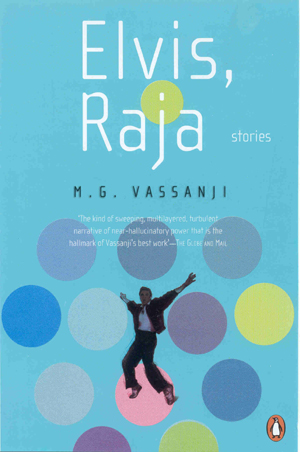
Elvis, Raja
M G Vassanji
Penguin
Pages: 218; Price: Rs 250
Rootlessness is also a problem with the second-generation American and British Indians, too. And all these children who may or may not have missed the
Vassanji, who is the author of five critically-acclaimed novels in the past and who is a name to reckon with among Canadian-Indian writers today, has penned twelve stories of migration, traumas, bitterness and hope (or is it hopelessness?). True, Vassanji has style — and in some stories substance — and his craft is thousand times better than the sob stories written by behanjis sitting in high-rise apartments of
Vassanji has got the drift right, and he does not try to bring in all the clichéd problems of the irritating Indians living abroad — like their love for pickles and agarbatti. Instead, he tries to focus on the extraordinary, vividly portraying his characters’ diverse dilemmas, sans losing grip of the Indian identity.
So far so fine. But the problem with this book is it has nothing new to say. Just another one dozen short stories. Maybe the exceptions, though not really, are the title story and When She Was Queen. In Elvis, Raja Rusty worships Elvis so crazily that he creates a shrine to the legendary singer. Diamond, his college chum, traumatised because of his unfaithful wife’s deeds, finds himself trapped in Rusty’s and the Pop King’s world of trance.
When She Was Queen gives an excellent peep into the lives of the Indian community living in
The tales range from Gujarat to
— Sunil K Poolani / Deccan Herald
Monday, December 04, 2006
A Salacious Tale
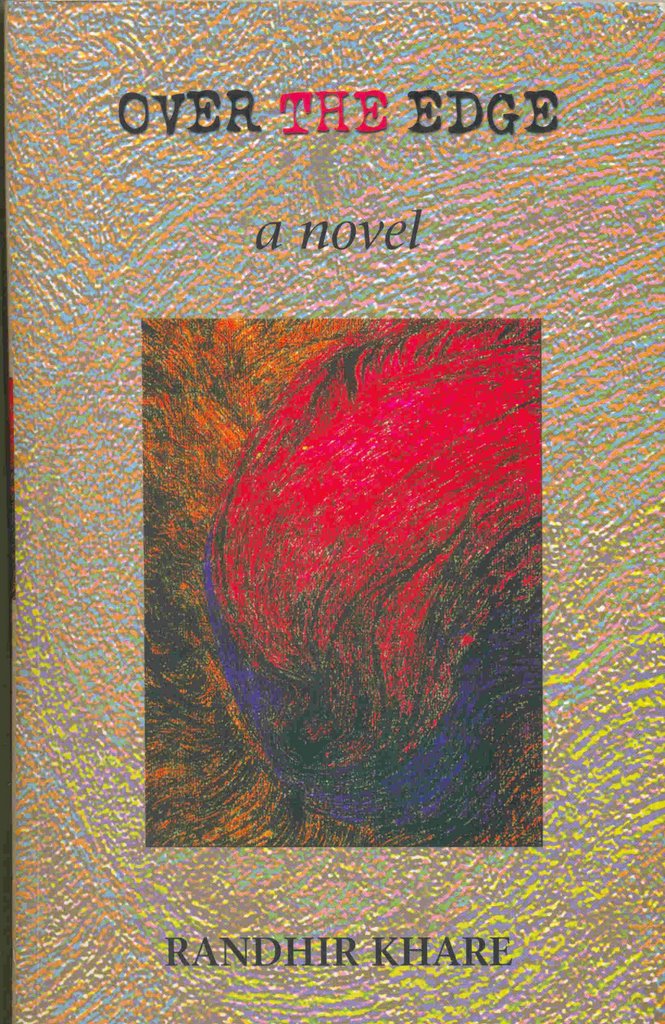
By Sunil K Poolani
Over the Edge
Rupa & Co
The storyline of the book (well, if there is one) is this: Biren (by all practical purposes a deranged guy) pays a visit to
So, when Biren reaches Zady’s flat, she is not there: gone for a month’s vacation to get more pleasure somewhere out. Biren here encounters Joseph Mellow, an old nutcase who is a part-time writer; Mellow’s favourite pastime is to jump from his balcony to Zady’s balcony like a chimpanzee.
The crazy characters do not end with them. See this array: Pepita, whose is better known as Ma G Spot; Maria, the Hawaiian-born wanderer conceived by hippy parents; Clarissa, the Swedish bombshell; Kimiki, the tiny Japanese; Sakoontala, who communicates through a flute and her voluptuous body; Benito, the Italian big-mouth; Swami Anandaneshwar, the massage specialist; the mysterious Swami Arjuna. All of them reek of sex — bad sex.
The blurb informs us that “the narrative is simple, colourful and oft times brutally honest.” Hardly. I have never seen a more blatantly lying book blurb like this. Okay, let’s come back to the story. Biren reaches
Now, sample this semi-porn passage (I am only reproducing the saner one; some of them will find space even in third-rate porno magazines that you find on Mumbai streets): “The general’s wife has been watching me from one corner of the bedroom. There she sits on a stool, rubbing herself between the legs with two fingers. When she discovers that the general is dead, she calls out to me, ‘come here, give it to me, give it to me’ (page 58). Why Rupa & Co decided to publish this ‘magnum opus’ looks like a mystery.
As if all these are not enough the production of the book is a reader’s nightmare. Two sentences in the end of page 38 are repeated in the beginning of page 39; and on page 40 two sentences seem to have been left out in the beginning.
While I am trying to find words to sum up this review, the author comes to my rescue (on page 90): ‘Is this a joke? A poor, sick joke?’ Thank you Randhir Khare, it could not have been more apt.
— Deccan Herald
Wednesday, August 23, 2006
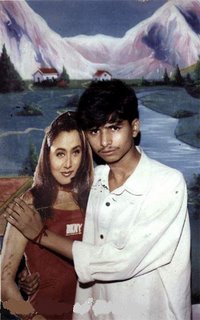
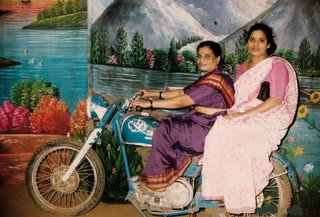
Old Habits Die Hard
These are the images of quintessential Indians. They never change how much ever money they get, wherever they are however the world might have techinically grown. Keep it up...

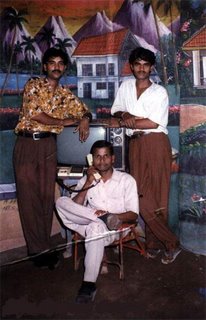
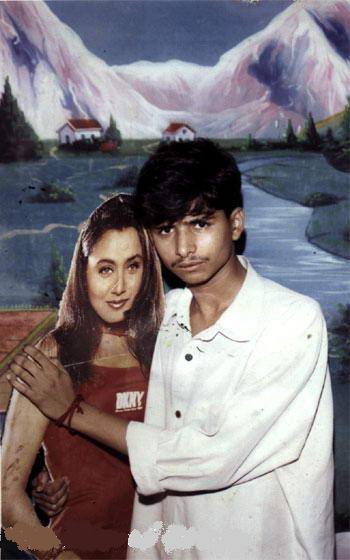


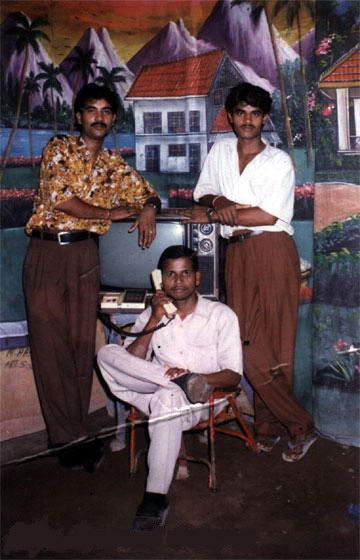
Friday, August 18, 2006
Revisiting a 30s' Supercity
------------------------------------
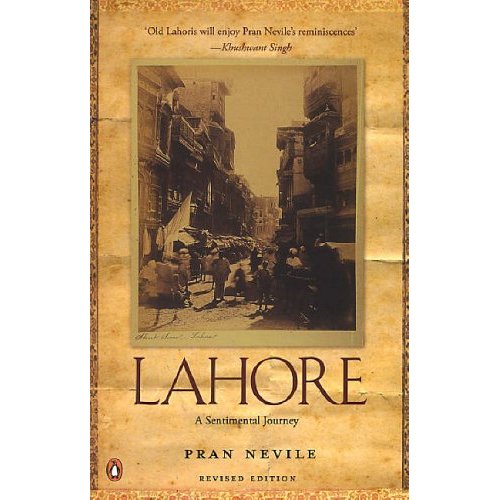
Lahore: A Sentimental Journey
(Revised edition)
Pran Nevile
Penguin
Pages: 207; Price: Rs 250
---------------------------------
A city is the confluence of many centuries-old travels, and travelling (and in this case back) to that city is a venerable ritual of accumulating the dust generated by these journeys in this span. For Pran Nevile, travelling back to his hometown, Lahore, is not like a backpacker crisscrossing the European capitals on a Eurorail trip. For Nevile, the umbilical cord with Lahore was snapped when the Indian subcontinent was violently divided, and revisiting the same is not just a sentimental journey but reopening old wounds, and it is so gentlemanly of him that he does not bother his readers with his personal losses.
Instead, what Nevile pens is a magnificent tribute to a city and its life of the 1930s and the 40s. The book talks about Lahore’s history in lucid detail; the emperors, plunderers, traders, builders, colonisers… We are made to understand that in that era, Lahore, apart from very few cities like Bombay, was the most happening place — be it cinema, cuisine, fashion, fun and frolic, politics, love and sex. Nevile has this uncanny knack to divide all these neatly into different chapters and talk about it enchantingly, peppered with Punjabi anecdotes and a bit of personal experiences.
While savouring the book, one was amazed at the life the Lahorias led. They had everything and even in 2006 it gives a feeling that we have nothing new that Lahore then possessed; no, we are not talking about laptops and cell phones.
The book starts befittingly: Lahore’s Anarkali, the queen of shopping centres in the Punjab. The chapter delves deep into Anarkali, a visit to which is considered a status symbol and in the whole of North India there was never such a market where shoppers offered almost anything under the sun.
Another interesting chapter is totally devoted to kite-flying. Why? “Kite-flying had been a passion with Lahorias who waxed eloquent of their kites and boasted of their accomplishments in this field.” Nevile has to offer numerous gems in this city’s passion for this sport — love, death, triumph, all mixed.
A city is an amalgamation of a whole range of elements: good, bad and ugly; wise and vice; sin and sincerity. Lahore is no different. So do not feel surprised when you see a whole chapter devoted to the “ace pimp of Lahore,” Fazal. There are other sections that deal with women and their changing attitude, live dance and song, miracles medicines and sex manuals, punters, bookies, politicians… The list is endless.
This new revised edition (the book, though conceived in 1963, was first published in 1993 and is achieving a cult status) is embellished with rare photographs, newspaper clippings, advertisements that jell well with the text. Some of the advertisements are uproariously hilarious. Savour one: “Wanted very sharp – a suitable match for a rich and healthy Khatri Engineer, age 35, drawing Rs 350 monthly, having a large Banking Account and willing to deposit Rs 10,000 in the name of his new wife.” Annexure like Songs of a Bygone Era, Select Bibliography and Glossary complete the picture. Despite all these plus points, the book, even in its third edition, is crying for a tighter editing.
Nevile, who has written extensively on Indian art and culture, is the author of many books on the Raj — and Lahore is the finest feather in his cap.
— Sunil K Poolani
(Deccan Herald; 13 August 2006)
Thursday, June 29, 2006
Who says Mumbai has no space?
Sunil K Poolani
“It’s cruel. It’s mean. Lacking as much in space as in courtesy; either you prosper or perish, take your pick.”
Encouraging words those. Especially coming, in one breath, from your cousin sister when this writer chose to fold tent in Delhi to make his uncertain way to scramble together a living in the then Bombay.
The year was 1992, and Bal Thackeray had not yet sicked his saffron louts on the minorities of Bhiwandi or Jogeshwari, and the city was swarming with millions.
Why was, you ma y ask. Isn’t today’s Mumbai the same as 1992, or for that matter, 1982 Bombay? Think again. Here is one city that has defied conventional wisdom; even made that wisdom stand on its head. It grew — and it is not as if you have seen the last of the trainloads of new migrants yet — like every other urban agglomeration. But, strikingly, the unceasing — unstoppable — dribble of human flotsam from elsewhere hasn’t quite choked Mumbai.
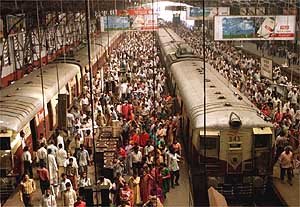
Far from it. In the early ’90s, the city apparently reached the pinnacle of its growth — not necessarily financially, but physically. Every morning people from the northern suburbs, and much beyond, even from Pune, packed themselves like sardines in that great lifeline called electric trains to reach downtown south. And the evenings saw the reverse flow.
The city population has been on the rise over the years, and there was no place to stay, squat or even stand in one of the most costliest metropolises of the world. The nerve-centre, of course, was Nariman Point and the adjoining Fort area, and the whole economy of the city, or the state, or the country, revolved around this district.
Anything overfilled has to burst, and it happened to this commercial hub — once a cluster of seven islands, which was, in 1661, presented as dowry to King Charles II of England when he married Princess Catherine de Braganza of Portugal. The burst (disintegration?) was almost unnoticed. In fact, it was not quite a violent one, but more like a big bang in a soundless, freeze-by-freeze slow motion.
As slowly, rather, as the clasp of tightening bodies on suburban trains (the best parameter to judge Mumbai's density) eventually started easing, and the space between flesh and flesh increased. And it took a few more years to realise that the city is not overcrowded anymore.
This may sound ludicrous to many a Mumbaiite, but, hello, you, just stop walking with the crowd, spare a minute of your choking schedule, and, for once, turn around to watch the crowd. Is the Great Unwashed still milling about you the way it was when you came to the city for the first time, say, five or ten years back, when you watched the Mumbai crowd in bemused helplessness?
Definitely not. Ergo, the city has changed. So, you might ask, how did it all happen? Obviously, no thanks to the efforts of the city fathers or the powerful BMC, admittedly the richest and most corrupt corporation in the country. Hand it to the enterprising denizens themselves — they started branching out, to the suburbs, to neighbouring boroughs in the Thane district, to the well-planned township of New Mumbai... and the crowd started dispersing.
Instead of the north-south-north daily grind, a whole range of new directions and reverse flows ensued. Instead of people massed like refugees and waiting for the predictable trains in particular hours of the day, the crowd got spread even. The modes of transport, too, changed: BEST buses, cabs, autos and even private vehicles — the latter being an unthinkable and non-practical thing to have in Mumbai till some years ago.
Several offices and small-scale factories sprung up in even residential areas of boroughs. And, with the exurbia coming to life, as it were, downtown Mumbai was not quite the same anymore. Come 6.30 pm, Monday (forget Saturday), and the swanky Nariman Point wears a deserted look — there were even reported cases of the highway robbery kind, the victims being those who had to work a couple of hours more.
Save for an HSBC or two, the fabled Fort area doesn't have snazzy offices anymore. Most offices, which could not afford exorbitant rentals at these places, have moved over to places like Parel, in central Mumbai, where they have set up spacious and affordable shop in what were once mill areas, the bread and butter of the city till a decade ago.
So, is it a welcome trend? Of course, yes, whichever way you slice it (except for the fact, perhaps, that there is a new pattern of unemployment becoming increasingly visible. But then, that is not restricted to Mumbai, is it?).
Just last week, this writer called up his Delhi cousin and assured her she has been proved wrong — eventually. And nobody knocked the caller down, as it used to happen. Once.
— Hindustan Times / 30 June 2006
“It’s cruel. It’s mean. Lacking as much in space as in courtesy; either you prosper or perish, take your pick.”
Encouraging words those. Especially coming, in one breath, from your cousin sister when this writer chose to fold tent in Delhi to make his uncertain way to scramble together a living in the then Bombay.
The year was 1992, and Bal Thackeray had not yet sicked his saffron louts on the minorities of Bhiwandi or Jogeshwari, and the city was swarming with millions.
Why was, you ma
 y ask. Isn’t today’s Mumbai the same as 1992, or for that matter, 1982 Bombay? Think again. Here is one city that has defied conventional wisdom; even made that wisdom stand on its head. It grew — and it is not as if you have seen the last of the trainloads of new migrants yet — like every other urban agglomeration. But, strikingly, the unceasing — unstoppable — dribble of human flotsam from elsewhere hasn’t quite choked Mumbai.
Far from it. In the early ’90s, the city apparently reached the pinnacle of its growth — not necessarily financially, but physically. Every morning people from the northern suburbs, and much beyond, even from Pune, packed themselves like sardines in that great lifeline called electric trains to reach downtown south. And the evenings saw the reverse flow.
The city population has been on the rise over the years, and there was no place to stay, squat or even stand in one of the most costliest metropolises of the world. The nerve-centre, of course, was Nariman Point and the adjoining Fort area, and the whole economy of the city, or the state, or the country, revolved around this district.
Anything overfilled has to burst, and it happened to this commercial hub — once a cluster of seven islands, which was, in 1661, presented as dowry to King Charles II of England when he married Princess Catherine de Braganza of Portugal. The burst (disintegration?) was almost unnoticed. In fact, it was not quite a violent one, but more like a big bang in a soundless, freeze-by-freeze slow motion.
As slowly, rather, as the clasp of tightening bodies on suburban trains (the best parameter to judge Mumbai's density) eventually started easing, and the space between flesh and flesh increased. And it took a few more years to realise that the city is not overcrowded anymore.
This may sound ludicrous to many a Mumbaiite, but, hello, you, just stop walking with the crowd, spare a minute of your choking schedule, and, for once, turn around to watch the crowd. Is the Great Unwashed still milling about you the way it was when you came to the city for the first time, say, five or ten years back, when you watched the Mumbai crowd in bemused helplessness?
Definitely not. Ergo, the city has changed. So, you might ask, how did it all happen? Obviously, no thanks to the efforts of the city fathers or the powerful BMC, admittedly the richest and most corrupt corporation in the country. Hand it to the enterprising denizens themselves — they started branching out, to the suburbs, to neighbouring boroughs in the Thane district, to the well-planned township of New Mumbai... and the crowd started dispersing.
Instead of the north-south-north daily grind, a whole range of new directions and reverse flows ensued. Instead of people massed like refugees and waiting for the predictable trains in particular hours of the day, the crowd got spread even. The modes of transport, too, changed: BEST buses, cabs, autos and even private vehicles — the latter being an unthinkable and non-practical thing to have in Mumbai till some years ago.
Several offices and small-scale factories sprung up in even residential areas of boroughs. And, with the exurbia coming to life, as it were, downtown Mumbai was not quite the same anymore. Come 6.30 pm, Monday (forget Saturday), and the swanky Nariman Point wears a deserted look — there were even reported cases of the highway robbery kind, the victims being those who had to work a couple of hours more.
Save for an HSBC or two, the fabled Fort area doesn't have snazzy offices anymore. Most offices, which could not afford exorbitant rentals at these places, have moved over to places like Parel, in central Mumbai, where they have set up spacious and affordable shop in what were once mill areas, the bread and butter of the city till a decade ago.
So, is it a welcome trend? Of course, yes, whichever way you slice it (except for the fact, perhaps, that there is a new pattern of unemployment becoming increasingly visible. But then, that is not restricted to Mumbai, is it?).
Just last week, this writer called up his Delhi cousin and assured her she has been proved wrong — eventually. And nobody knocked the caller down, as it used to happen. Once.
— Hindustan Times / 30 June 2006
Subscribe to:
Posts (Atom)